
Bonhoeffer, Black resistance, and fascism
Interlude

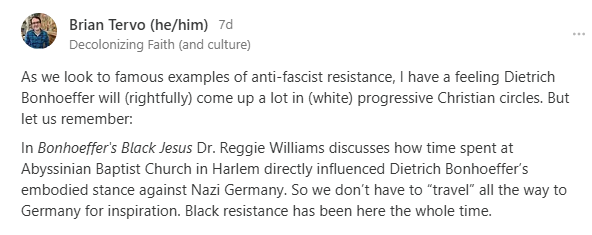
A note I posted on Substack recently got a bit of attention (see above). Clearly the current political climate in this country has a lot of us on edge. And even if we’re a far way off from the most lethal possibilities of fascism, similarities between this administration and 1930s Germany are becoming clear daily.
The Nazis were notoriously inspired by the American Jim Crow and Native reservation systems. Likewise, American resistance to those violent systems inspired the ways in which folks like Bonhoeffer resisted.
For some, this resistance started young. In Night Flyer: Harriet Tubman and the Faith Dreams of a Free People, Tiya Miles quotes Harriet Tubman reflecting on an instance in her childhood after refusing to join her enslaver’s family prayers while praying a prayer of her own:
“And I prayed to God … to make me strong and able to fight, and that’s what I’ve always prayed for ever since.” (p. 48)
The white abolitionist to whom she recounted this story “tried to ‘persuade’ Tubman that this sort of prayer was ‘wrong'.’ But Tubman rejected [her] interpretation, insisting the prayer was not only ‘right’ but also ‘sincere.’” (p. 48-49) Even well intentioned white folks didn’t grasp the gravity of American slavery and even tried to dictate how the enslaved worshiped and resisted.
So when Dietrich Bonhoeffer arrived in America in 1930 to study for a year at Union Theological Seminary in New York, it wasn’t his progressive white classmates who taught him how to resist fascism. It was a Black seminarian friend and his church. In Bonhoeffer’s Black Jesus: Harlem Renaissance Theology and an Ethic of Resistance, Dr. Reggie Williams writes:
“Bonhoeffer’s experience in Harlem demonstrates that a Christian interpretation of the way of Jesus must be connected to justice for a Christian to see beyond primary loyalties to self and kind, to recognize the needs for justice in another’s context, and to ‘love neighbor as self.’” (p. 141)
Bonhoeffer learned to “recognize the needs of justice in another’s context” in Harlem. Towards the end of his essay “After Ten Years” from his Letters and Papers from Prison, Bonhoeffer wrote:
“It remains an experience of incomparable value that we have for once learned to see the great events of world history from below, from the perspectives of the outcasts, the suspects, the maltreated, the powerless, the oppressed and reviled. In short from the perspective of the suffering.” (p. 52)
While I’m sure he had the Jews of Germany in mind as he wrote this, it also echoes his experience at Abyssinian Baptist Church—an experience that equipped him with the knowledge of methods of solidarity required to effectively resist the Nazi regime. As a privileged member of German society, Bonhoeffer wouldn’t have inherently known what it was like to experience history “from below.” It was something he would have had to learn. And it appears he did. He was openly outspoken against the Nazis, trained students at an illegal seminary, was involved in an operation to smuggle Jews out of Germany, and (at least peripherally) participated in a plot to overthrow the Nazi regime.1 This all led to his imprisonment and execution.
These are all forms of resistance he could have learned from Black history. A.J. Sanderlin ran a school in the American South for Black people at great cost to his own finances and safety.2 Harriet Tubman and Thomas Smallwood helped people escape slavery. And Nat Turner attempted to overthrow the slave system. These are just a few examples of a culture of resistance that would have informed the Christianity that Bonhoeffer experienced at Abyssinian.
So while Dietrich Bonhoeffer (and the broader Confessing Church movement) is indeed a model for resisting fascism, I don’t think we need to look that far. I fear focusing too much in that direction (i.e. “we’re becoming 1930s Germany”) obscures the fact that we have our own violent and oppressive history which prompted its own resistance movement(s)—movements and histories that are continuously threatened by book bans and attacks on DEI, affirmative action, and “wokeness” (all seemingly used by this administration as pejoratives for “Black”).
Perhaps we won’t have to make the ultimate sacrifice that he made, but we may be called to support and protect our undocumented neighbors. Or hire people of color and LGBTQIA+ folks despite attacks on DEI in the workplace. Or pressure our elected officials to protect marriage equality, civil rights legislation, transgender rights, and public assistance programs currently under threat. The movements and histories that inspired Bonhoeffer can also guide us.
Though, as Rev. Dr. Stephen G. Ray points out in his book Do No Harm: Social Sin and Christian Responsibility, Bonhoeffer often used language that, perhaps unconsciously, reinforced Christian supremacy. According to Ray, Bonhoeffer seemed “[unaware] of the anti-Semetic language loop he was trapped inside. Bonhoeffer would have had to use an exclusively positive discourse entirely to challenge the anti-Semetic presuppositions of the Aryan clauses effectively.” However, “he did not engage in this type of discourse; he did not say anything positive about Jews as Jews or challenge the fundamental notion of Jewish difference.” (p. 91). Rather than argue for Jewish life on its own terms, according to Ray, he seems to have fallen into the trap of condescendingly arguing for Jewish life as subordinate to German Christian culture. In an effort to defend the Jewish people, he still “othered” them. In this, Bonhoeffer “demonstrated how even the best intentions can go askew the moment we buy into this language game.” (p. 96)
See chapter 12 of A High and Noble Mission: The Adventist Outreach to African-Americans During the Civil War Era and Beyond by Robert Price.